The Leaning Tower of Pisa: A Private Guide to Italy’s Most Famous Monument
The Leaning Tower of Pisa has been tilting toward the Tuscan sky for over 800 years — and yet most visitors spend less than 20 minutes with it. They photograph the tilt, pose for the obligatory “holding it up” shot, and move on without ever learning why it leans, how close it came to collapse, or what makes the entire Campo dei Miracoli one of the most audacious architectural ensembles in the medieval world. That is the difference between visiting Pisa and understanding it.
This guide gives you the full picture: the history, the engineering drama, the practical logistics, and the insider perspective that only a private expert guide can provide.
What Is the Leaning Tower of Pisa, and Why Does It Lean?
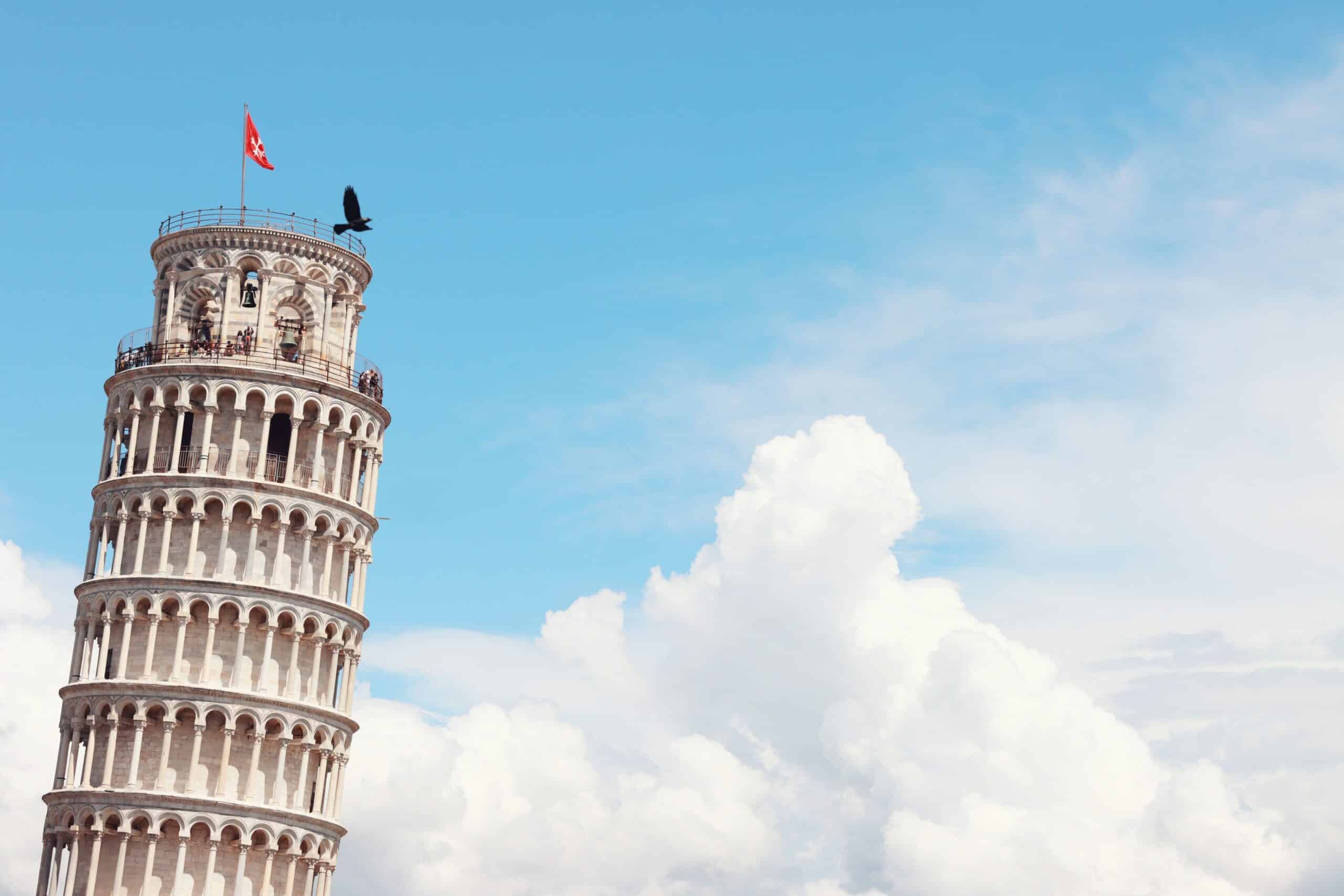
The tower is the freestanding campanile, or bell tower, of the Cathedral of Pisa. Construction began in 1173 and stretched, with long interruptions for wars and political upheaval, across nearly two centuries. Its architect remains a subject of scholarly debate — Bonanno Pisano receives the most frequent attribution, though the evidence is contested.
The lean is not an accident of neglect. It began almost immediately, when builders had completed only the first three stories. The subsoil beneath the southern side of the tower is notably softer than the north, a mixture of clay, fine sand, and shells that compresses unevenly under load. Construction halted for nearly a century, and that pause — unintentional as it was — allowed the soil to consolidate and the structure to gain a degree of stability it would not have otherwise achieved.
When construction resumed in the 13th century, builders compensated by making the upper stories slightly taller on the short (southern) side, attempting to counteract the tilt. This adjustment gave the tower a subtle banana-shaped curvature visible to a careful eye. By the time the bell chamber was added in the 14th century, the tilt was pronounced and, apparently, accepted as permanent.
By the late 20th century, the tower leaned at more than five degrees from vertical. Engineers calculated that without intervention, it would topple within decades. Between 1990 and 2001, an international team of soil engineers undertook one of the most delicate stabilization projects in architectural history: removing carefully measured quantities of earth from the northern side, allowing the tower to correct itself by approximately 44 centimeters. The tilt now sits at just under four degrees — still dramatic, still photogenic, and structurally sound for at least another 200 years.
The Campo dei Miracoli: More Than a Tower
Pisa’s great medieval complex takes its poetic name — the Field of Miracles — from a writer who called it just that in the 11th century. The name stuck, and it fits. The Campo dei Miracoli is not a single monument but a collection of four interconnected masterworks arranged with deliberate magnificence on a broad expanse of green.
The Cathedral anchors the composition. Its white marble facade, layered with delicate blind arcades and completed in the 12th and 13th centuries, established the Pisan Romanesque style that influenced church architecture across Tuscany and Sardinia for generations. Step inside when access allows and the nave opens up in tiers of pale marble and ancient columns, with Giovanni Pisano’s intricately carved pulpit standing as one of the supreme achievements of medieval sculpture. The building survived a devastating fire in 1595 and subsequent restoration — some original treasures were lost, but the space retains a grave, luminous beauty.
The Baptistery is the largest in Italy. Its circular form and layered Gothic crown (added after the Romanesque base was completed) make it an architectural conversation between centuries. Acoustically, it is extraordinary: a single voice, sung clearly inside, produces overtones that echo and layer into something approaching harmony. Guides demonstrate this phenomenon regularly, and the effect is genuinely arresting — the kind of thing that stays with you long after you have forgotten the architectural dates.
The Camposanto, the monumental cemetery, encloses a cloister of extraordinary size along the northern edge of the Campo. Medieval tradition held that its soil came from Golgotha, brought back from the Holy Land during the Crusades — sacred earth for sacred burials. The cloister walls were once covered entirely in 14th and 15th-century frescoes, many destroyed in a catastrophic Allied bombing raid in 1944. What remains, including the haunting “Triumph of Death” attributed to the Buffalmacco master, speaks with raw power about mortality and judgment.
Together, these four buildings form a total work of civic and religious ambition: a medieval republic telling the world, in marble and mathematics, that it had arrived.
Local Expert Tip
Most visitors approach the Campo dei Miracoli from the eastern gate near the tower itself. Enter instead from the western side, near the Camposanto. You get the full panoramic view of all four buildings simultaneously, with the tower rising behind the cathedral and baptistery in a single frame. The morning light falls most favorably on the cathedral facade from this angle. Arrive before 9am in summer and you will have the lawn almost to yourself for photographs.
If you plan to climb, book your timed entry weeks in advance during high season. Slots sell out. The climb requires 294 steps on a narrow, spiraling staircase that tilts perceptibly underfoot — you genuinely feel the lean with your body, not just your eyes. The view from the top takes in Pisa’s terracotta rooftops, the Arno valley, and on clear days the marble peaks of the Apuan Alps to the north.
The History Behind the Lean: Pisa as a Maritime Republic
Understanding the Leaning Tower means understanding what Pisa was in the 11th and 12th centuries. The city was not the quiet university town it appears today. It was a naval power, a trading republic that competed directly with Genoa, Venice, and Amalfi for dominance of Mediterranean commerce. Pisan ships carried crusaders to the Holy Land and returned with silks, spices, and wealth. The Campo dei Miracoli was built on the proceeds of that empire.
The Cathedral was founded in 1063 after a naval victory over the Saracens near Palermo. The bell tower followed. The entire complex was a victory monument dressed in sacred architecture — a way of translating military and mercantile success into permanent, marble-clad glory. When you stand at the base of the tower and look at the cathedral’s luminous facade, you are looking at the ambition of a city at the height of its power.
Pisa’s dominance did not last. Naval defeat at the Battle of Meloria in 1284 ended the city’s Mediterranean supremacy. The harbor silted up, trade routes shifted, and Florence eventually absorbed the city entirely. What survived was the Campo dei Miracoli: a monument to a greatness that the city itself could no longer sustain. That tension between the monument and the diminished city around it gives the place a melancholy grandeur that purely triumphant monuments rarely achieve.
Why a Private Tour Makes the Difference
Pisa receives more than five million visitors annually. On a standard day in July or August, the Campo dei Miracoli is dense with tour groups, selfie sticks, and hawkers selling novelty souvenirs. A private guide cuts through all of that.
With a private expert from ArtViva, the visit is structured around your pace and curiosity rather than a group itinerary. Families with children get the scientific story of the lean told in terms that genuinely excite young minds. Architecture enthusiasts receive the full Romanesque stylistic analysis. Photographers learn which angles and which times of day reward patience. Couples looking for a romantic Tuscan afternoon get the human stories: the architects who argued, the engineers who saved the tower, the painters who recorded its image for centuries.
A private guide also manages the practical friction that ruins many visits to high-traffic sites: timed entry reservations, interior access windows, the logistics of combining the tower with the cathedral and Camposanto in a single coherent morning. You arrive knowing that the plan works.
Climbing the Tower: What to Expect
The tower climb is optional but deeply worthwhile for most visitors. Here is what to know before you decide.
The ascent covers 294 marble steps on a helical staircase built into the tower’s hollow walls. The steps are worn smooth by centuries of foot traffic and are narrower than any staircase you will encounter in daily life. The tilt is physically present: your body adjusts instinctively to the lean, and the sensation is simultaneously disorienting and exhilarating.
Children under 8 years old are not permitted to climb. Those with vertigo, mobility difficulties, or claustrophobia may find the experience uncomfortable. For everyone else, the top offers a view across Pisa that photographs do not fully capture: the green rectangle of the Campo below, the dense medieval roofline of the city, and the flat Arno valley stretching toward the sea.
Timed entry is strictly enforced. Groups enter in batches and are given a fixed window. Book well in advance, particularly between April and October.
Planning Your Visit: Practical Logistics
Getting there from Florence: Pisa is approximately 80 kilometers west of Florence, roughly an hour by fast train or slightly longer by car. ArtViva can arrange private chauffeured transfers for those who prefer door-to-door comfort without the logistics of Italian train stations.
Best time to visit: The Campo dei Miracoli is open year-round. Spring (April to June) offers mild temperatures and long light. September and early October bring golden afternoon quality without the peak-summer density of crowds. Winter visits — particularly January and February — reward those who accept the cold with near-empty grounds and extraordinary light on the marble facades.
What to wear: The Cathedral and Baptistery are active sacred sites. Shoulders and knees must be covered for entry; modest attire is expected throughout. Comfortable, flat shoes are essential — the marble surfaces are polished and can be slippery, and the tower staircase demands sure footing.
How long to allow: A properly paced private tour of the full Campo dei Miracoli takes two to three hours on site. Include the tower climb and you should allow the full three hours. Add travel time from Florence and a lunch stop in central Pisa or the nearby walled city of Lucca, and you have a full, satisfying day.
The Leaning Tower of Pisa: Frequently Asked Questions
Why does the Leaning Tower of Pisa lean? The tilt results from soft, unstable subsoil on the tower’s southern side. Clay and silt compress unevenly under the weight of the structure, causing it to tilt during the early phases of construction in the 12th century. The lean was partially corrected between 1990 and 2001 by removing soil from the northern side, reducing the tilt from over five degrees to just under four.
Can you climb the Leaning Tower of Pisa? Yes, with a timed ticket reserved in advance. The climb involves 294 steps on a narrow, spiraling staircase. Children under 8 years old are not permitted. The view from the top is exceptional.
How long does a tour of the Campo dei Miracoli take? A thorough private tour takes two to three hours on site, covering the tower, the cathedral interior, the Baptistery, and the Camposanto.
Is the Leaning Tower of Pisa UNESCO-listed? Yes. The entire Campo dei Miracoli — including the cathedral, baptistery, tower, and Camposanto — has been a UNESCO World Heritage Site since 1987.
What is the best time of day to visit the Leaning Tower of Pisa? Early morning, before 9am, offers the best light on the cathedral’s marble facade and the lowest crowd density. Sunset visits, when available, produce spectacular warm light on the entire complex.
Do I need advance tickets to enter the Campo dei Miracoli? Entrance to the grounds is free. Entry to the individual monuments, including the cathedral, baptistery, Camposanto, and tower, requires tickets. Tower climbs require timed reservations, which should be booked weeks in advance during high season.
Can I visit the Leaning Tower of Pisa as a day trip from Florence? Absolutely. Pisa is about an hour from Florence by fast train or private transfer. A morning departure from Florence allows a full visit to the Campo dei Miracoli and a return to Florence by early evening, with time for lunch in Pisa.
What makes the Pisan Romanesque style distinctive? The Pisan Romanesque style is characterized by exterior blind arcading in horizontal registers, the use of striped polychrome marble, slender colonnaded galleries stacked on facades, and a refinement of surface detail that distinguishes it from the heavier Lombard Romanesque to the north. The Cathedral facade is its finest surviving expression.
Combining Pisa with Lucca: The Perfect Pairing
Pisa and Lucca sit just 20 kilometers apart, connected by a comfortable road through flat Tuscan farmland. Many travelers find that a single day serves both cities well, particularly with private transport.
Lucca is one of the most intact medieval cities in Italy. Its Renaissance walls — wide enough at the top for a promenade, a cycle path, and a row of trees — encircle a dense historic center of Roman-grid streets, Romanesque churches, and piazzas built on the footprint of a Roman amphitheater. The pace is slow, the crowds are manageable compared to Florence or Siena, and the food is exceptional. A late lunch of tortelli lucchesi (local pasta filled with meat and served with ragù) in a trattoria off the main piazzas makes for an ideal transition between the grandeur of Pisa and the train or car back to Florence.
ArtViva’s Leonardo da Vinci, Pisa and Lucca private day trip covers all three destinations in a single, well-structured itinerary.
A Note on Galileo and the Tower
Every guide to Pisa mentions Galileo. He was born in Pisa in 1564 and studied and later taught at the university, which was already one of the oldest in Europe. The famous story holds that he dropped cannonballs of different weights from the top of the Leaning Tower to demonstrate that objects fall at the same rate regardless of mass, directly contradicting Aristotelian physics.
Most historians consider this story apocryphal — a dramatic narrative attached to the right city and the right scientist. Galileo did conduct experiments on falling bodies, though likely inclined-plane experiments rather than tower drops. But the legend serves a purpose: it locates Pisa at the intersection of medieval spectacle and early modern scientific thinking, which is not entirely wrong. The same city that built a tower beautiful enough to survive its own structural failure also produced one of the minds that began to unmake the medieval worldview.
Reserve Your Private Pisa Experience with ArtViva
For over 25 years, ArtViva has led private, expert-guided experiences across Italy. Every guide is licensed, deeply knowledgeable, and selected for both scholarly rigor and the ability to make history come alive for curious travelers of every background.
A private tour of the Campo dei Miracoli with ArtViva includes tailored commentary at your pace, advance entry reservations for all monuments, optional timed tower climb booking, and concierge coordination for transfers from Florence, Lucca, the Tuscan coast, or cruise ports.
This is not a rushed group tour with a flag to follow. It is a private, curated encounter with one of the great architectural achievements of the medieval world — on your terms, at your pace, with a guide who genuinely loves what they are showing you.
Spaces fill quickly, particularly between April and October. Contact ArtViva now to confirm your date and begin planning a Pisa experience worth remembering. Book The Leaning Tower of Pisa Tour now!
ArtViva has been creating private, expert-led tours in Italy since 1996. Licensed, insured, and trusted by thousands of discerning travelers each year.