
Florence Gardens and Views: The Living Landscape Above the City
Florence gardens and views are not simply scenic stops on a map. They are part of how the city understands itself, shaped over centuries through faith, power, art, and cultivation. From hilltop monasteries to Renaissance landscapes, these spaces reveal Florence as both a city and a carefully composed horizon.
For many visitors, the beauty of Florence is concentrated in its piazzas and museums. Yet the deeper story lies just above and beyond them, where gardens and elevated viewpoints open the city into layers of green, stone, and sky.
History & Cultural Context of Florence’s Gardens
Florence’s gardens developed alongside its rise as a center of power and artistic innovation. During the Renaissance, gardens were not merely decorative spaces. They were expressions of order, philosophy, and control over nature.
The Medici family played a defining role in shaping this landscape language. Their estates introduced structured geometry, sculpted hedges, fountains, and classical statues that reflected ideals of harmony and intellectual ambition. Over time, these principles spread across the city’s villas and hillside estates.
At the same time, religious communities maintained quieter, contemplative green spaces on elevated ground. These locations were chosen for both spiritual reflection and practical visibility over the city below. What emerges today is a layered system of gardens that reflects Florence’s shifting identity across centuries.
Why Florence Gardens and Views Matter Today
In a city defined by artistic density, gardens offer a different kind of understanding. They slow the experience down. They create distance from the streets while revealing how intentionally Florence was shaped.
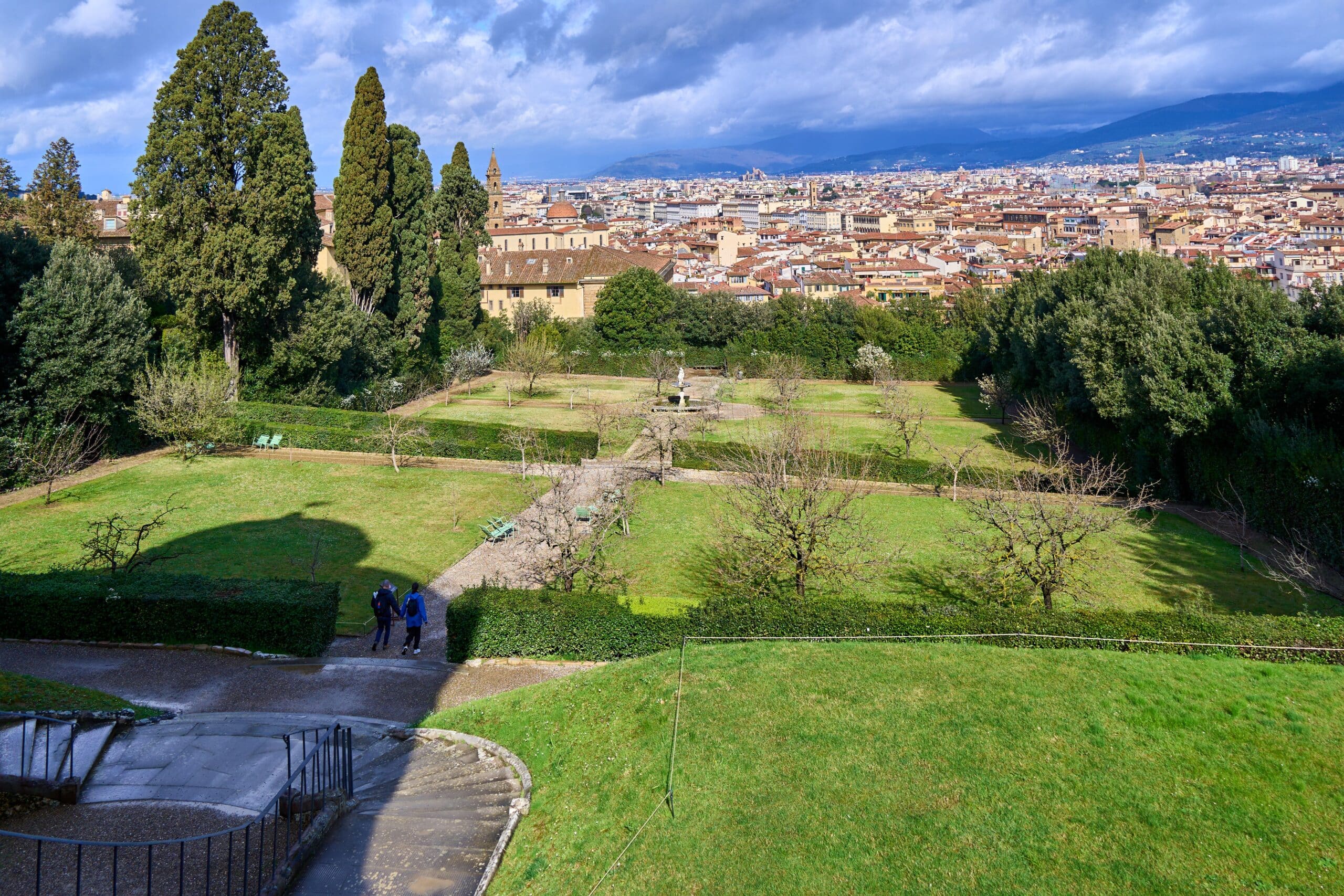
Many visitors overlook how these elevated spaces change perception. From above, the city becomes legible. Rooflines align with river curves. Bell towers emerge through cypress silhouettes. The Duomo anchors everything as both structure and symbol.
What most travelers never realize is that Florence’s identity is not only built in stone, but framed by green space. The gardens act as visual breathing points, allowing the city to be read as a continuous composition rather than isolated landmarks.
Local Expert Tip: Florence Gardens
Local experts often point out that Florence reveals its most honest proportions in the late afternoon light. As the sun lowers, terraces and gardens soften the city’s architectural sharpness, and the skyline begins to feel almost hand-painted.
They also note that the relationship between elevation and perspective is central here. A few minutes of walking uphill can completely change how Florence is understood, shifting from street-level detail to broad historical panorama.
Practical Travel Advice for the Florence Gardens
Florence’s gardens and viewpoints are best experienced at an unhurried pace. Comfortable walking shoes are essential, as many of these spaces involve gradual ascents, stone paths, and uneven surfaces.
Early morning and late afternoon are the most rewarding times to visit. Midday light can flatten the city’s depth, while softer hours enhance texture and contrast across rooftops and hills.
It is also worth allowing time between locations. The experience is not about checking off viewpoints but about observing how each one reframes the city differently.
Seasonal Considerations for the Florence Gardens
Spring brings layered color across terraced gardens, with wisteria, roses, and fresh green growth softening architectural lines.
Summer offers long, golden evenings where viewpoints remain warm well past sunset, creating extended opportunities for panoramic photography.
Autumn introduces clearer air and stronger visibility across the valley, with quieter paths and deeper tones in the landscape.
Winter, though less crowded, reveals the structure of Florence more starkly, with bare branches framing monuments and distant hills more clearly than in any other season.
Frequently Asked Questions about the Florence Gardens
What are the best gardens in Florence for views?
Florence offers several historic gardens and elevated spaces where landscaped terraces open onto wide city panoramas, combining nature with Renaissance design.
Are Florence gardens more historical or natural?
They are both. Many were designed as extensions of architectural and philosophical ideas during the Renaissance, blending nature with symbolic structure.
When is the best time to explore Florence viewpoints?
Late afternoon is ideal, when softer light enhances the city’s textures and highlights the layered skyline.
Do Florence gardens require advance planning?
Some historic gardens may require timed entry or seasonal access considerations, so checking availability ahead of time is recommended.
Florence as a Landscape of Perspective
Florence gardens and views reveal a city that was never built to be seen from a single angle. Instead, it unfolds through elevation, light, and layered design. Each terrace and hillside offers a different reading of the same urban story.
The deeper story lies in how intentionally Florence integrates nature and architecture into a shared visual language, where gardens are not separate from the city but essential to understanding it.
For travelers who want to experience Florence beyond its streets and monuments, exploring its gardens and viewpoints with knowledgeable local insight offers a more complete sense of place. Artviva helps travelers connect these layers, revealing Florence as it was meant to be seen: in depth, in context, and in perspective.
Why Artviva
Exploring Florence’s gardens and viewpoints with Artviva means understanding the city as a designed landscape rather than a collection of sights. With expert local guidance, the experience focuses on how elevation, perspective, and history work together to shape Florence’s most iconic views.
Instead of simply moving between panoramas, Artviva helps you read what you are seeing—connecting Medici landscapes, monastic hillsides, and hidden terraces into a single narrative of the city. The result is a slower, more meaningful way of experiencing Florence from above and within.
Learn more about The Most Beautiful Gardens and Views in Florence Tour and book your experience.