
A Parent’s Guide to Exploring the Uffizi Gallery with Kids
Walking into Florence with children changes the way the city reveals itself. What adults see as Renaissance perfection, kids often see as scale, color, movement, and questions waiting to be answered. Nowhere is this contrast more striking than inside the Uffizi Gallery, where centuries of art can either overwhelm a family or become one of the most memorable shared experiences of a trip to Italy.
The difference is rarely about the art itself. It is about how it is approached.
Seeing Florence Through Younger Eyes
Florence rewards curiosity. A carved lion on a building corner, a painted angel hidden in a frame, a statue tucked into a quiet piazza. Children naturally notice what adults rush past. The Uffizi extends this instinct indoors, where every room holds layers of stories that can feel either distant or alive depending on how they are revealed.
For families, the challenge is not whether the art is interesting. It is how to make it feel accessible without losing its depth.
Inside the gallery, works by Botticelli, Leonardo da Vinci, and Michelangelo are often presented as masterpieces of art history. For a child, they become something else entirely when framed as questions: Who is she? Why is the wind blowing so strongly? What is hidden in the background? Suddenly, the gallery stops being a sequence of rooms and becomes a narrative space.
Why the Uffizi Works for Families
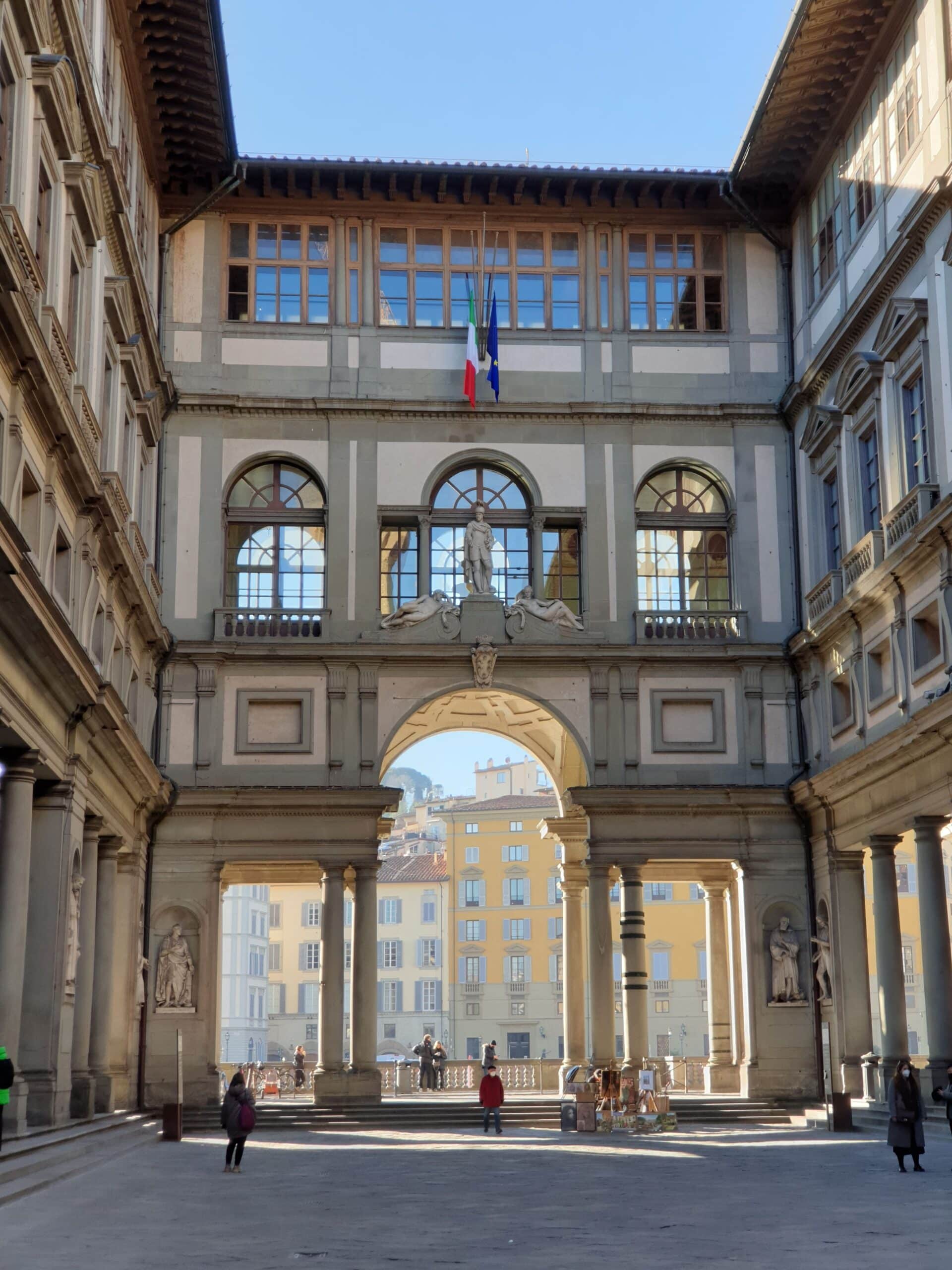
The Uffizi is one of the oldest museum spaces in the world, originally built as offices for the Medici family before becoming a gallery of extraordinary importance. Its structure naturally encourages storytelling. Long corridors, rhythmic rooms, and dramatic reveals of iconic works create a sense of progression that children understand instinctively.
Rather than trying to see everything, families benefit from slowing down and focusing on recognition rather than coverage. A single painting can hold enough detail to spark ten different conversations. That is often where the real engagement begins.
One parent recently described it simply: the moment their child realized that artists were once real people solving visual problems, the entire visit changed.
How Children Naturally Engage with Renaissance Art
Children rarely respond to art in the way guidebooks expect. They notice expressions before symbolism, animals before allegories, and stories before technique. The Renaissance rewards this way of seeing.
A painting like Botticelli’s “Birth of Venus” becomes less about mythology and more about movement, wind, and emotion. A Leonardo portrait becomes a puzzle about personality. Even religious scenes become human stories when broken down into gestures, faces, and relationships.
This shift is important. Once children feel invited to interpret rather than memorize, the museum becomes interactive without any physical interaction at all.
The Role of Storytelling in Museums
Florence has always been a city of storytellers. Painters, architects, and patrons used visual language to communicate power, belief, and identity. When families approach the Uffizi through storytelling, they are not simplifying the art. They are reconnecting it to its original purpose.
Stories create memory. Facts alone rarely do.
A detail about a painter’s rivalry, a strange object hidden in a corner of a canvas, or a symbolic animal used to represent a family can turn a painting into something a child remembers years later. These moments often become the emotional anchor of a trip.
A Different Pace of Travel in Florence
Traveling through Florence with children encourages a slower rhythm. The city itself supports this. Distances are walkable, piazzas invite pauses, and gelato becomes part of the natural pacing of the day.
The Uffizi fits into this rhythm best when it is not treated as a checklist. A shorter, more focused visit often creates a stronger impression than attempting to cover every masterpiece. Families leave with clarity instead of fatigue.
This approach also changes how parents experience the museum. Instead of managing time and attention, they often find themselves observing their children’s reactions, which becomes its own form of discovery.
When Art Becomes Shared Experience
One of the most unexpected outcomes of visiting the Uffizi with children is how often the experience becomes collaborative. Adults bring context, children bring observation, and together they create meaning that neither would reach alone.
A detail noticed by a child can open a conversation about history. A story told by a guide can trigger a question that reshapes how a painting is understood. These exchanges tend to stay with families long after they leave Florence.
Local Insight for Families Visiting Florence
Florence rewards early starts and intentional pacing. The Uffizi is most enjoyable when paired with open time afterward, ideally in a nearby piazza or garden where children can reset their attention.
It also helps to allow space for curiosity outside the museum. Spotting architectural details on the walk back, or discussing favorite paintings over gelato, reinforces what was seen inside without pressure.
The city is at its best when it is not rushed.
History and Cultural Context
The Uffizi began as administrative offices for the Medici family, one of the most influential dynasties in Renaissance Europe. Over time, their private collection evolved into a public archive of artistic innovation. The works housed here reflect not only religious devotion and mythological storytelling, but also competition, experimentation, and the rise of artistic identity.
Understanding this context adds depth for older children and accompanying adults, but even younger visitors respond to the idea that these works were once part of real lives and real decisions, not just distant history.
Frequently Asked Questions about Florence for Kids
Is the Uffizi suitable for children?
Yes, especially when approached with a focus on storytelling, key highlights, and interactive interpretation rather than full coverage.
How long should a family spend inside?
Around two hours is often ideal. It allows enough time for engagement without fatigue.
Can a visit work for different age groups together?
Yes. Mixed-age families often benefit the most, as older children and adults interpret details differently and share perspectives naturally.
Final Thought
Florence does not ask families to choose between culture and connection. It quietly offers both, especially in places where history is expressed visually rather than verbally.
Inside the Uffizi, the real value is not only what is seen, but how it is seen together.
For families willing to slow down and look closely, the gallery becomes less about learning art history and more about sharing a way of seeing the world.
Contact ArtViva to experience the Uffizi Gallery Tour for kids.
Turn a visit to one of the world’s greatest museums into an unforgettable family adventure with Artviva’s Florence For Kids – Uffizi Gallery Tour where Renaissance masterpieces come to life through stories, discovery, and fun.